Last Updated on 09.04.2026 by Vasyl Holiney
AI has become a game changer across many industries. People use it for vibe coding, writing articles, and generating videos.
We asked marketers, designers, copywriters, and other professionals how they use AI in their daily work – which tasks they automate, what tools they rely on, and whether they’re worried that AI might take their jobs in the near future.
So, what did we find out?
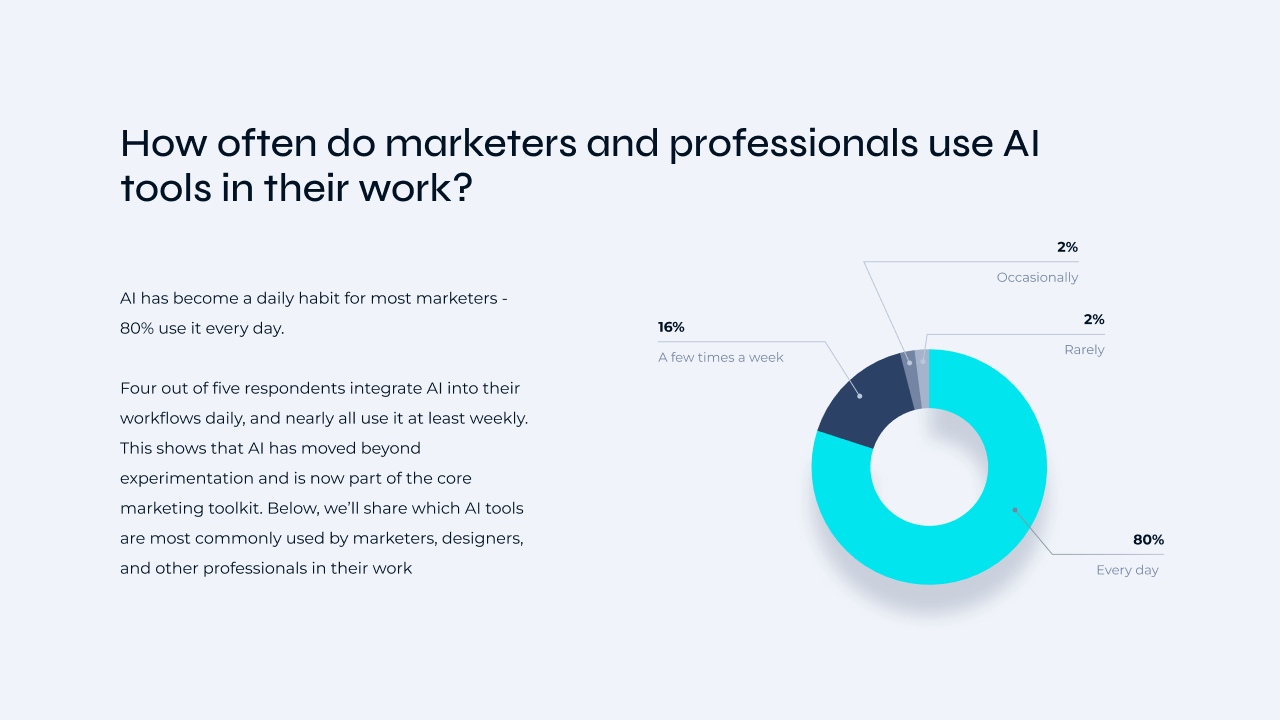
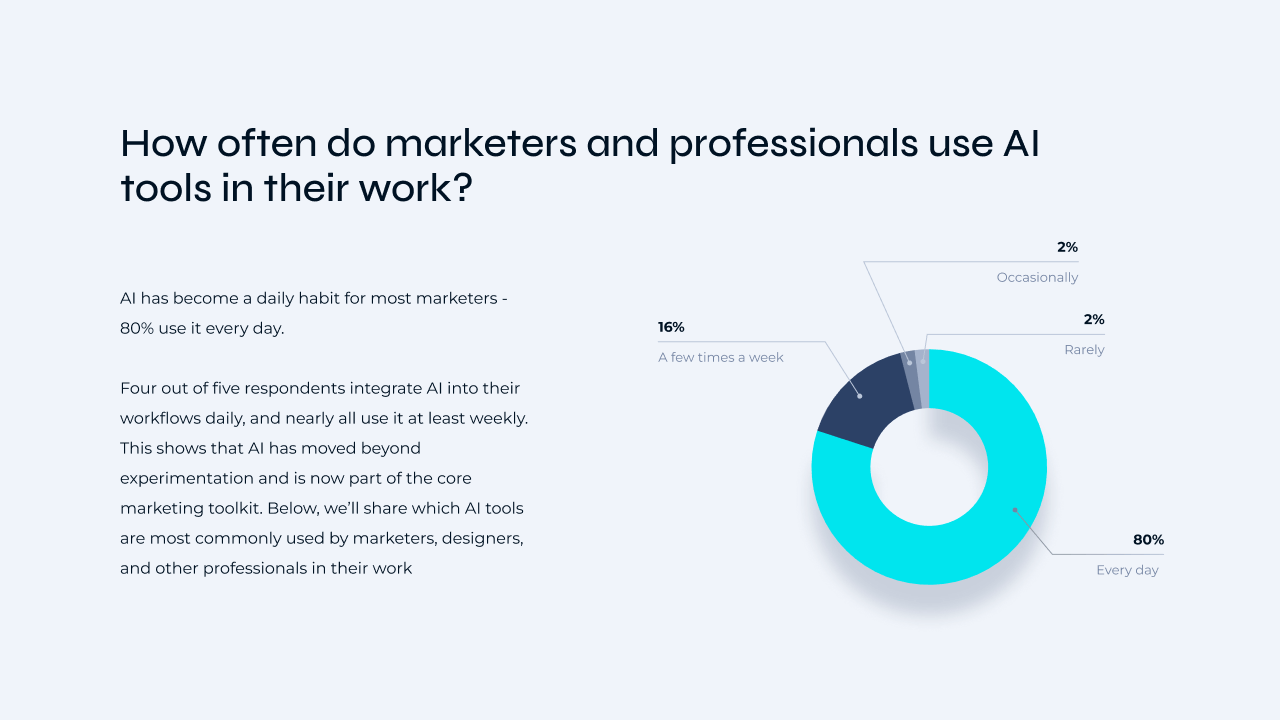
How often do marketers and professionals use AI tools in their work?
AI has become a daily habit for most marketers – 80% use it every day.
Four out of five respondents integrate AI into their workflows daily, and nearly all use it at least weekly.
This shows that AI has moved beyond experimentation and is now part of the core marketing toolkit.
Below, we’ll share which AI tools are most commonly used by marketers, designers, and other professionals in their work
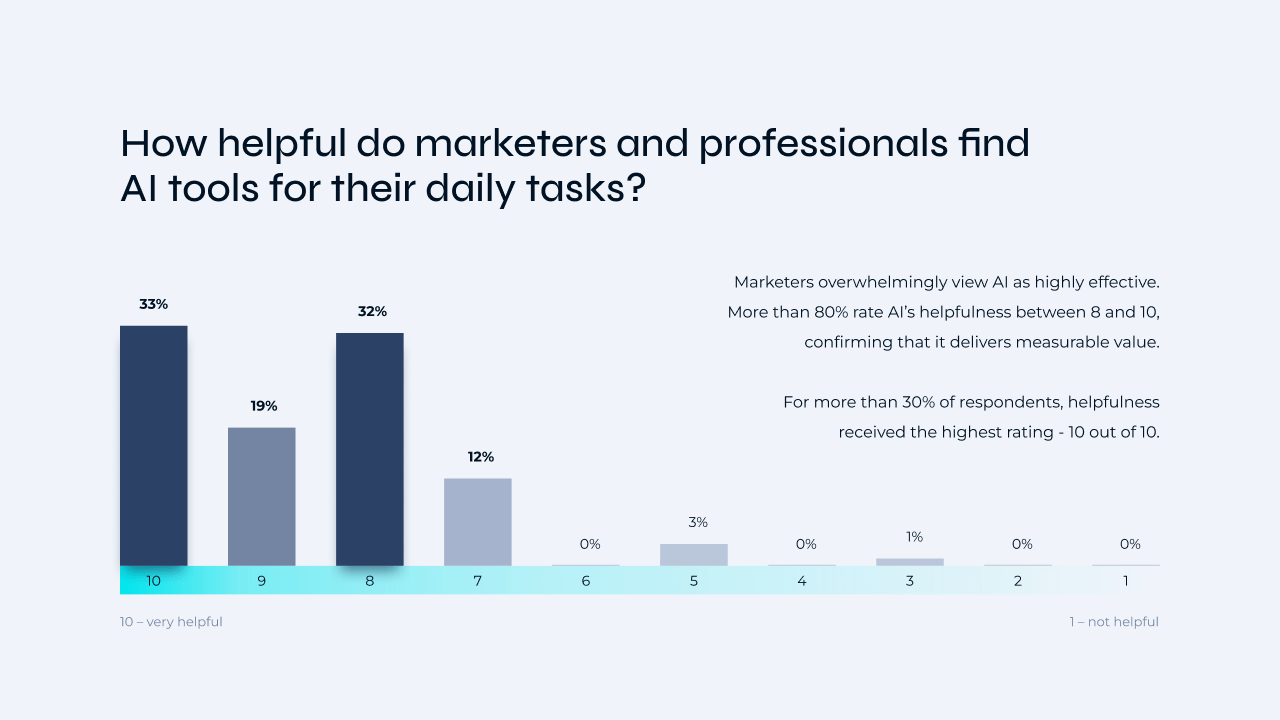
How helpful do marketers and professionals find AI tools for their daily tasks?
Marketers overwhelmingly view AI as highly effective.
More than 80% rate AI’s helpfulness between 8 and 10, confirming that it delivers measurable value.
For more than 30% of respondents, helpfulness received the highest rating – 10 out of 10.
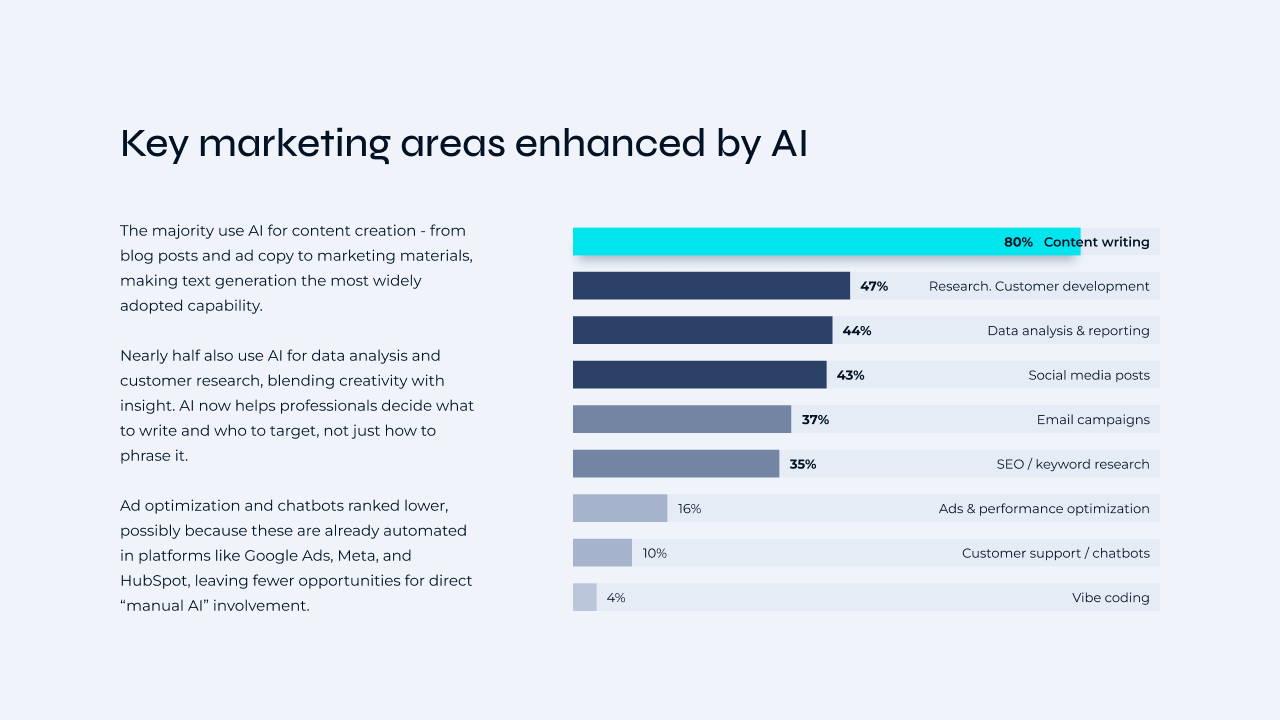
Key marketing areas enhanced by AI
The majority use AI for content creation – from blog posts and ad copy to marketing materials, making text generation the most widely adopted capability.
Nearly half also use AI for data analysis and customer research, blending creativity with insight. AI now helps professionals decide what to write and who to target, not just how to phrase it.
Ad optimization and chatbots ranked lower, possibly because these are already automated in platforms like Google Ads, Meta, and HubSpot, leaving fewer opportunities for direct “manual AI” involvement.
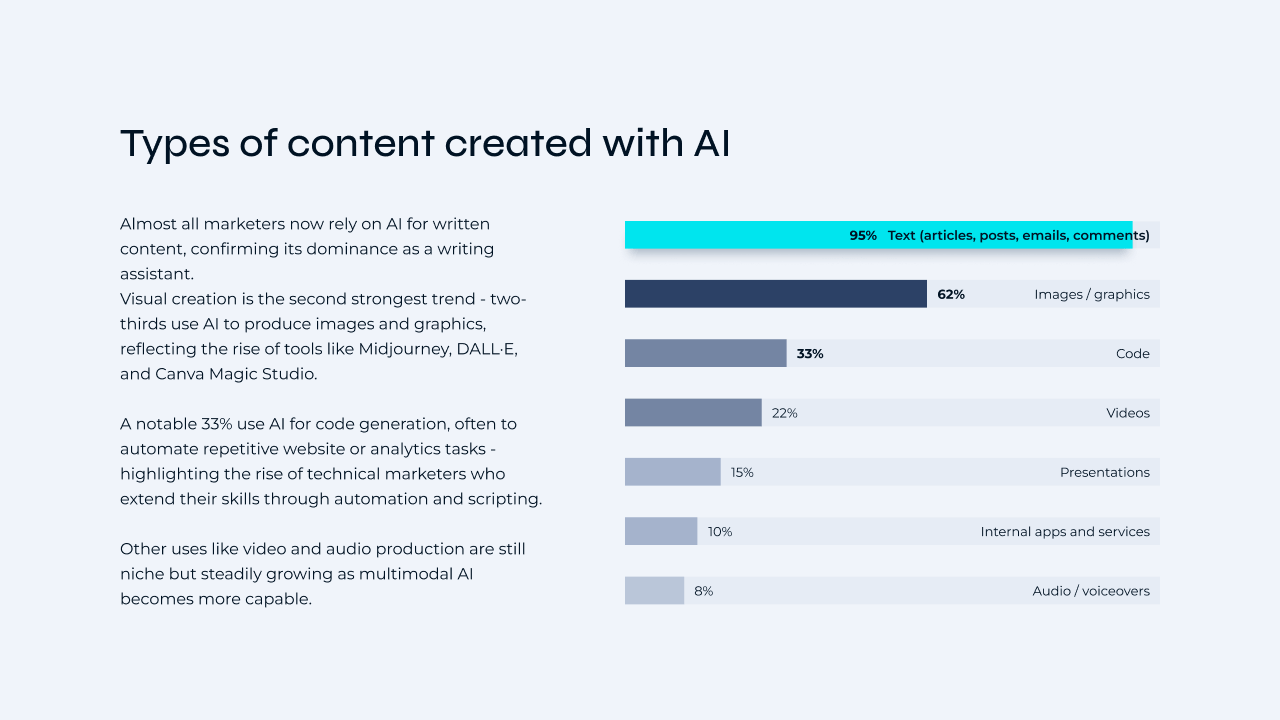
Types of content created with AI
Almost all marketers now rely on AI for written content, confirming its dominance as a writing assistant.
Visual creation is the second strongest trend – two-thirds use AI to produce images and graphics, reflecting the rise of tools like Midjourney, DALL·E, and Canva Magic Studio.
A notable 33% use AI for code generation, often to automate repetitive website or analytics tasks – highlighting the rise of technical marketers who extend their skills through automation and scripting.
Other uses like video and audio production are still niche but steadily growing as multimodal AI becomes more capable.
I don’t use AI as a shortcut. I use it as a strategic amplifier. I bring the context, direction, and marketing intuition while AI brings speed, structure, and synthesis. With AI, I can quickly turn raw ideas into polished insights and scalable content. It’s not automation. I see it as a collaboration.
— Mirjana Mijatovic, Partnership Manager, Mailtrap
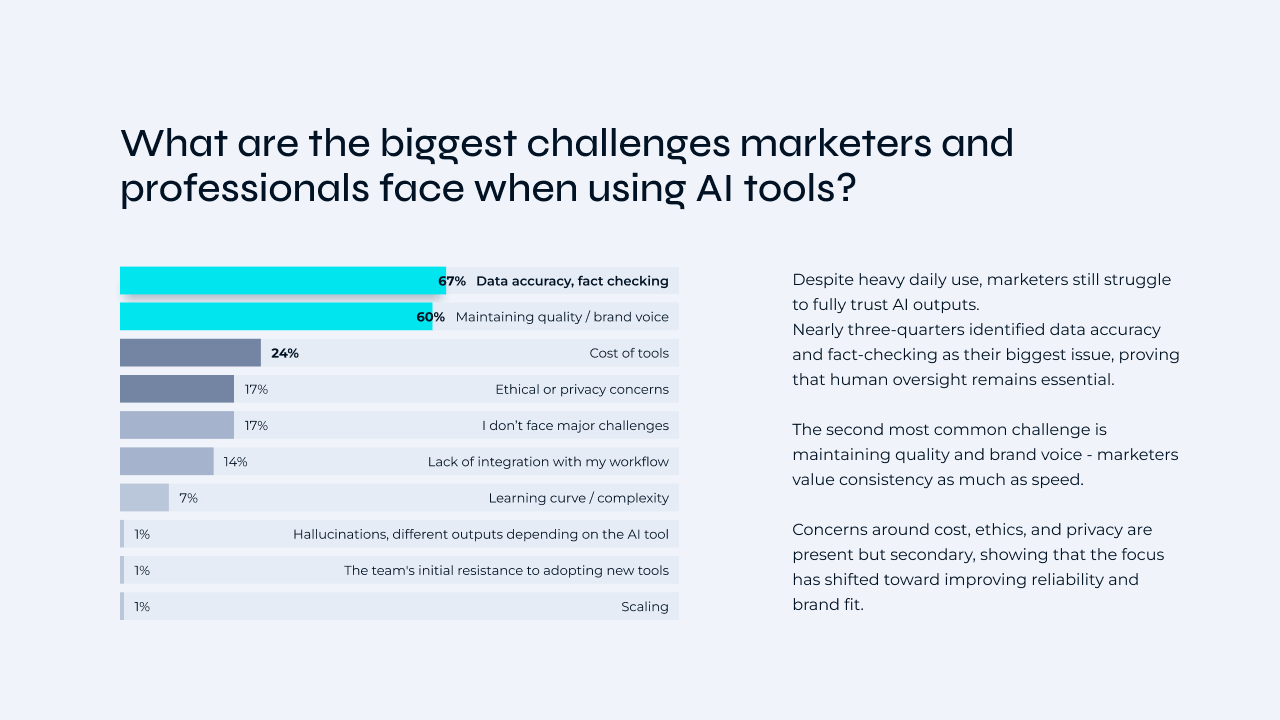
What are the biggest challenges marketers and professionals face when using AI tools?
Despite heavy daily use, marketers still struggle to fully trust AI outputs.
Nearly three-quarters identified data accuracy and fact-checking as their biggest issue, proving that human oversight remains essential.
The second most common challenge is maintaining quality and brand voice – marketers value consistency as much as speed.
Concerns around cost, ethics, and privacy are present but secondary, showing that the focus has shifted toward improving reliability and brand fit.
Interestingly, one in five respondents reported no major challenges, indicating growing confidence among advanced users who have already built strong AI workflows.
Do marketers and professionals use AI tools for personal or professional branding?
More than 34% of marketers are actively experimenting with AI for personal or professional branding – generating ideas, planning content, and shaping their online identity.
Another 45% use AI occasionally for content ideas, writing, or visual design, but not on a regular basis.
Tools like MySignature and Wisery show how AI can elevate personal branding, helping professionals design AI-customized email signatures, digital business cards, and link-in-bio pages that keep their brand identity consistent across every interaction.
However, only one in five use AI consistently, meaning branding remains an early adoption area compared with content or analytics.
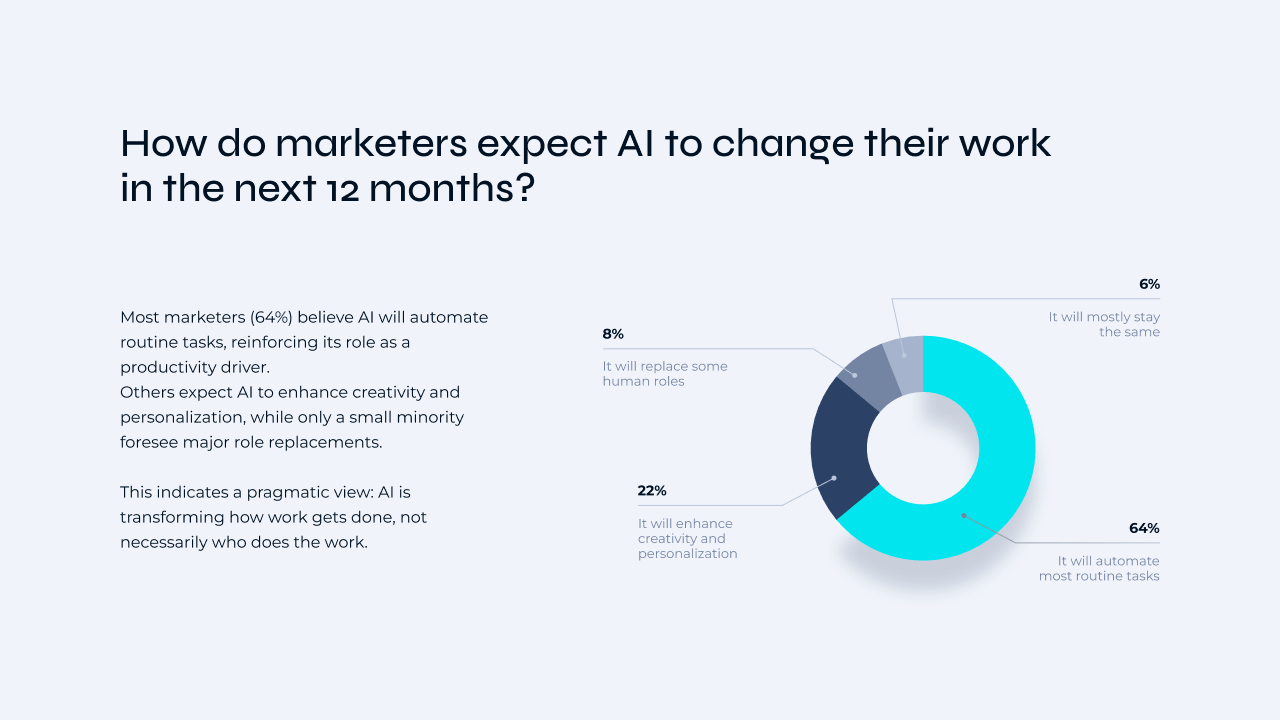
How do marketers expect AI to change their work in the next 12 months?
Most marketers (64%) believe AI will automate routine tasks, reinforcing its role as a productivity driver.
Others expect AI to enhance creativity and personalization, while only a small minority foresee major role replacements.
This indicates a pragmatic view: AI is transforming how work gets done, not necessarily who does the work.
I genuinely believe AI can automate about 95% of what we do. But that remaining 5%, oh boy, they make all the difference. There’s no way humans will be replaced by AI – unless you rely 100% on it, outsourcing your thinking. In that case, yes, you will be replaced because machines are cheaper.
— Yuliia Shvetsova, Co-Founder & CMO O-CMO
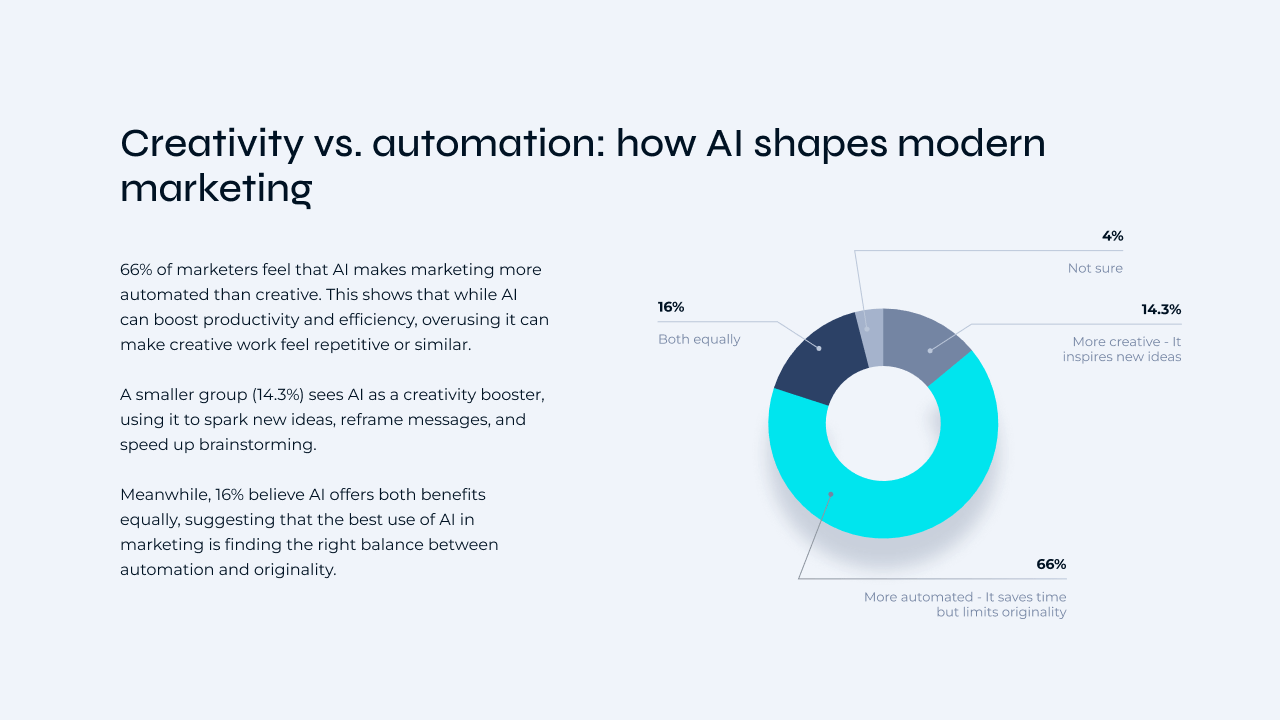
Creativity vs. automation: how AI shapes modern marketing
66% of marketers feel that AI makes marketing more automated than creative. This shows that while AI can boost productivity and efficiency, overusing it can make creative work feel repetitive or similar.
A smaller group (14.3%) sees AI as a creativity booster, using it to spark new ideas, reframe messages, and speed up brainstorming.
Meanwhile, 16% believe AI offers both benefits equally, suggesting that the best use of AI in marketing is finding the right balance between automation and originality.
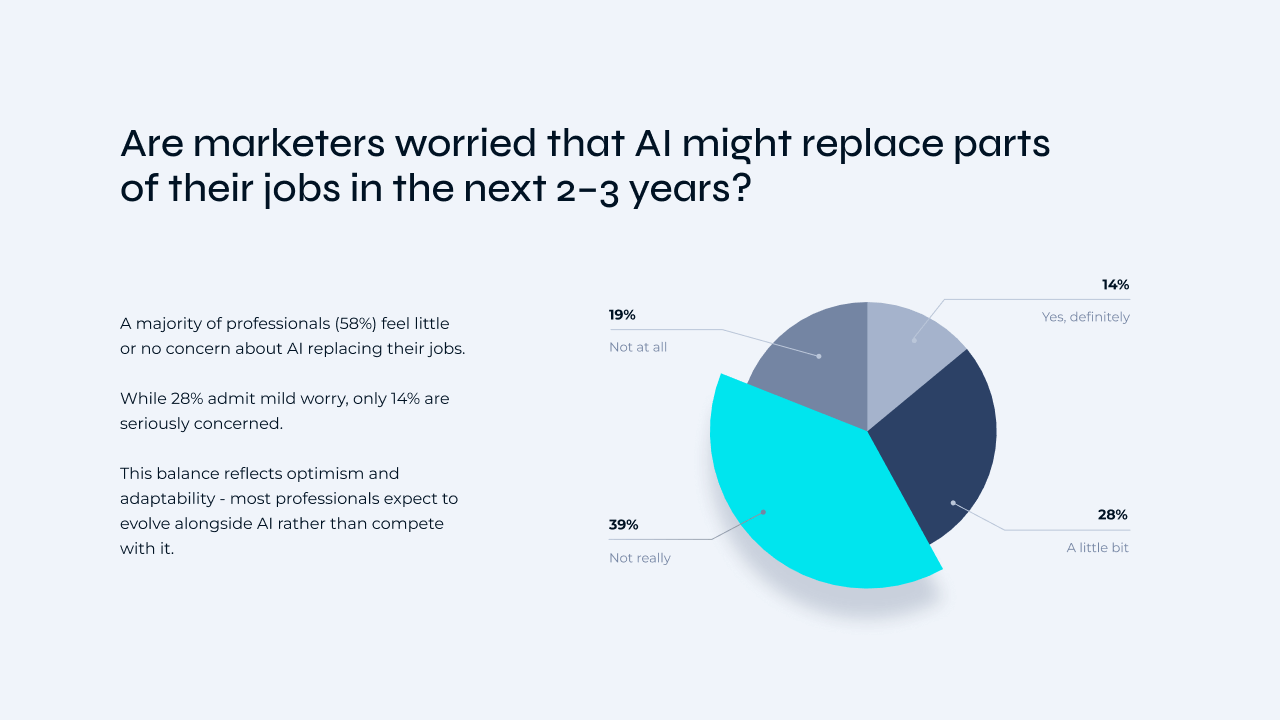
Are marketers worried that AI might replace parts of their jobs in the next 2–3 years?
A majority of professionals (58%) feel little or no concern about AI replacing their jobs.
While 28% admit mild worry, only 14% are seriously concerned.
This balance reflects optimism and adaptability – most professionals expect to evolve alongside AI rather than compete with it.
Marketers don’t fear replacement – they expect evolution. AI is viewed less as a rival and more as a collaborator.
— Vasyl Holiney, PMM at Solva.
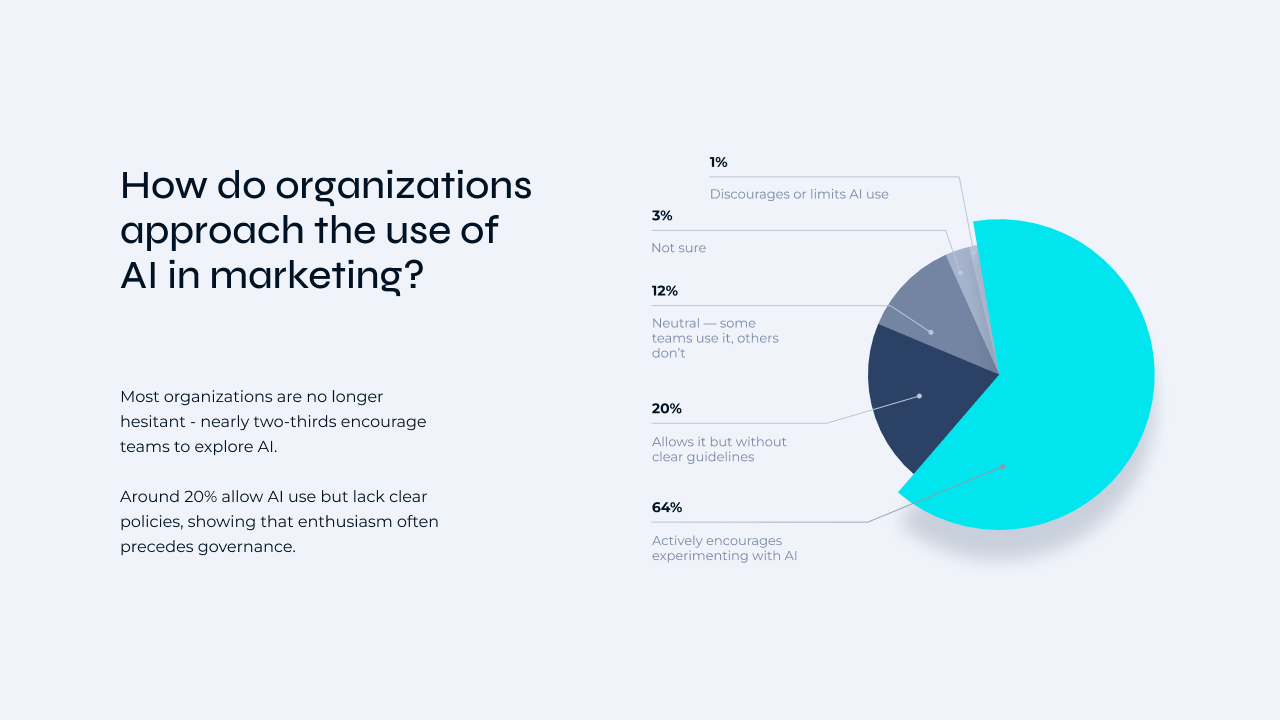
How do organizations approach the use of AI in marketing?
Most organizations are no longer hesitant – nearly two-thirds encourage teams to explore AI.
Around 20% allow AI use but lack clear policies, showing that enthusiasm often precedes governance.
A small portion of companies remain neutral or cautious, focusing on compliance and ethical adoption before full-scale integration.
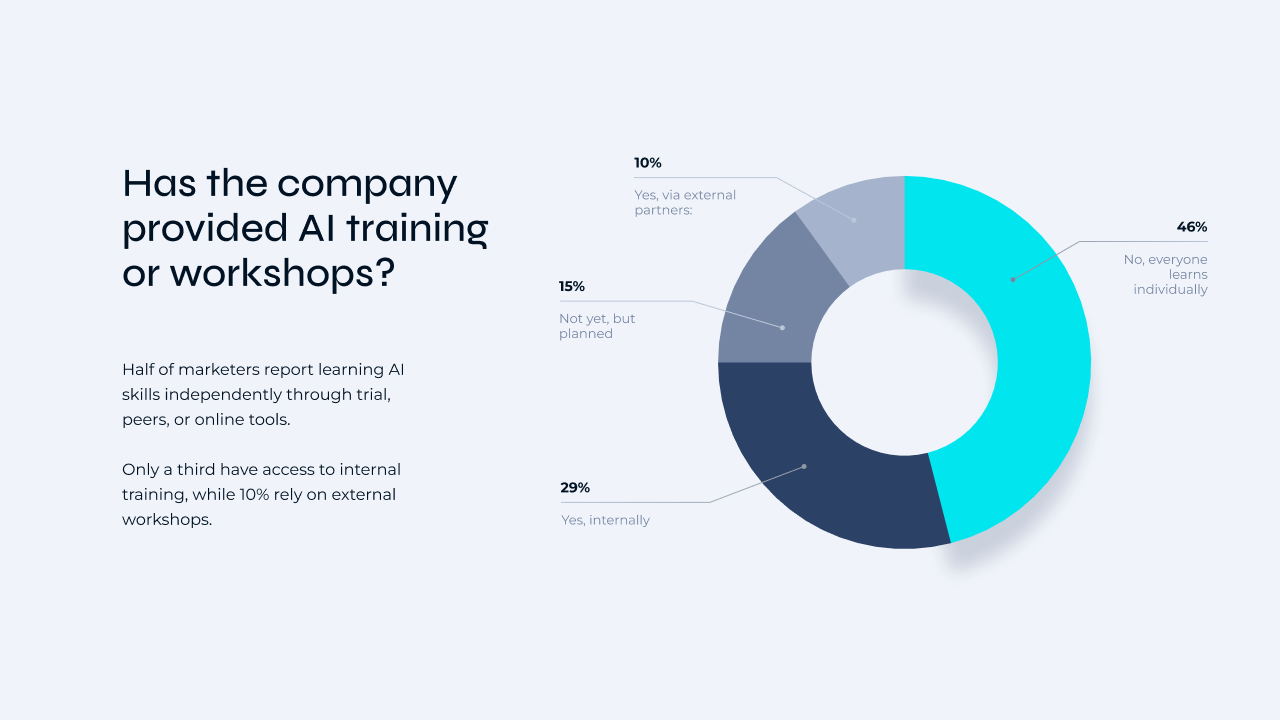
Has the company provided AI training or workshops?
Half of marketers report learning AI skills independently through trial, peers, or online tools.
Only a third have access to internal training, while 10% rely on external workshops.
This highlights an emerging skills gap – AI adoption is rising faster than structured education.
Organizations may support experimentation but often lack formal training frameworks, leaving professionals to self-educate.
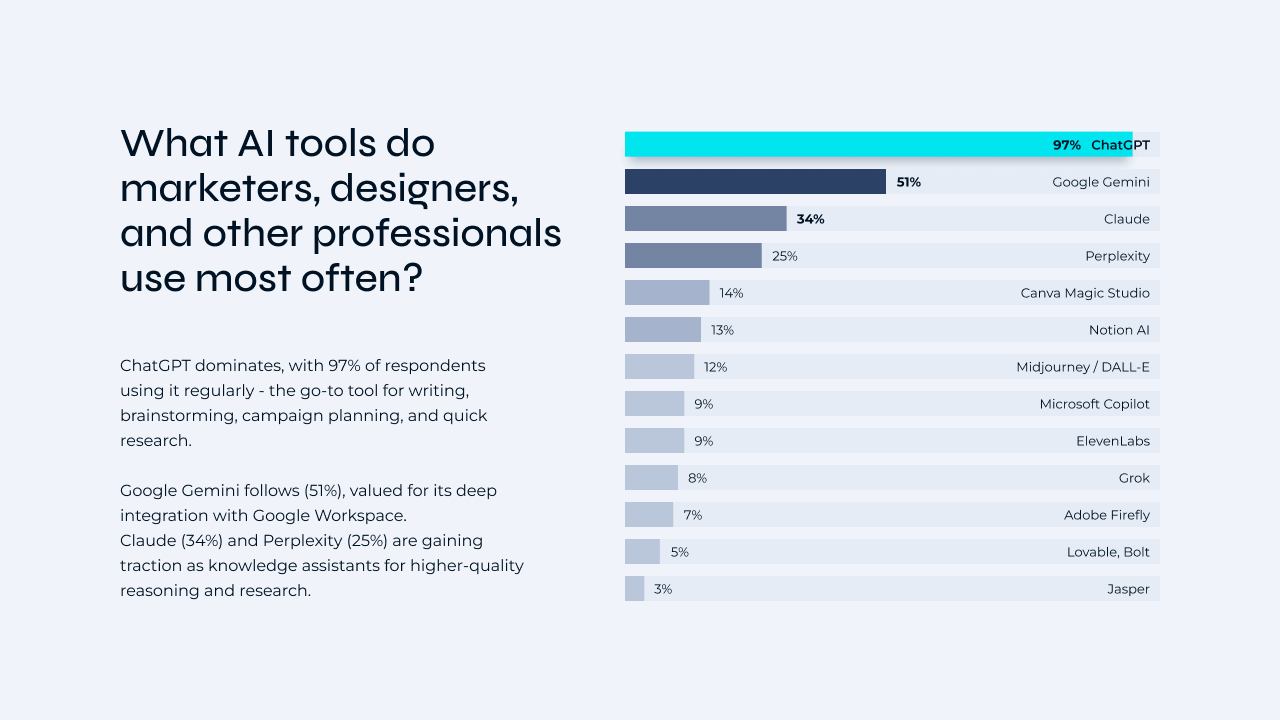
What AI tools do marketers, designers, and other professionals use most often?
ChatGPT dominates, with 97% of respondents using it regularly – the go-to tool for writing, brainstorming, campaign planning, and quick research.
Google Gemini follows (51%), valued for its deep integration with Google Workspace.
Claude (34%) and Perplexity (25%) are gaining traction as knowledge assistants for higher-quality reasoning and research.
Creative platforms like Midjourney, DALL-E, and Canva Magic Studio are popular for visual content, while tools such as Copilot, Notion AI, and Adobe Firefly represent the trend toward embedded AI – where intelligence lives inside everyday productivity software rather than standalone models.
Final Insights
AI is mainstream.
80% of marketers now use AI daily, and most find it indispensable for both creativity and productivity.
Content remains king.
Writing and visual creation dominate AI use, bridging the gap between creativity and data-driven insight.
Trust and accuracy matter.
Despite high adoption, professionals still struggle with data validation and tone alignment – proving that human oversight remains key.
AI is changing roles, not replacing them.
Most professionals see AI as a collaborator that automates the repetitive, not a threat to their careers.
Education is lagging behind innovation.
While organizations encourage experimentation, half of professionals still learn AI independently, pointing to a need for structured learning paths.
Who took part in our survey
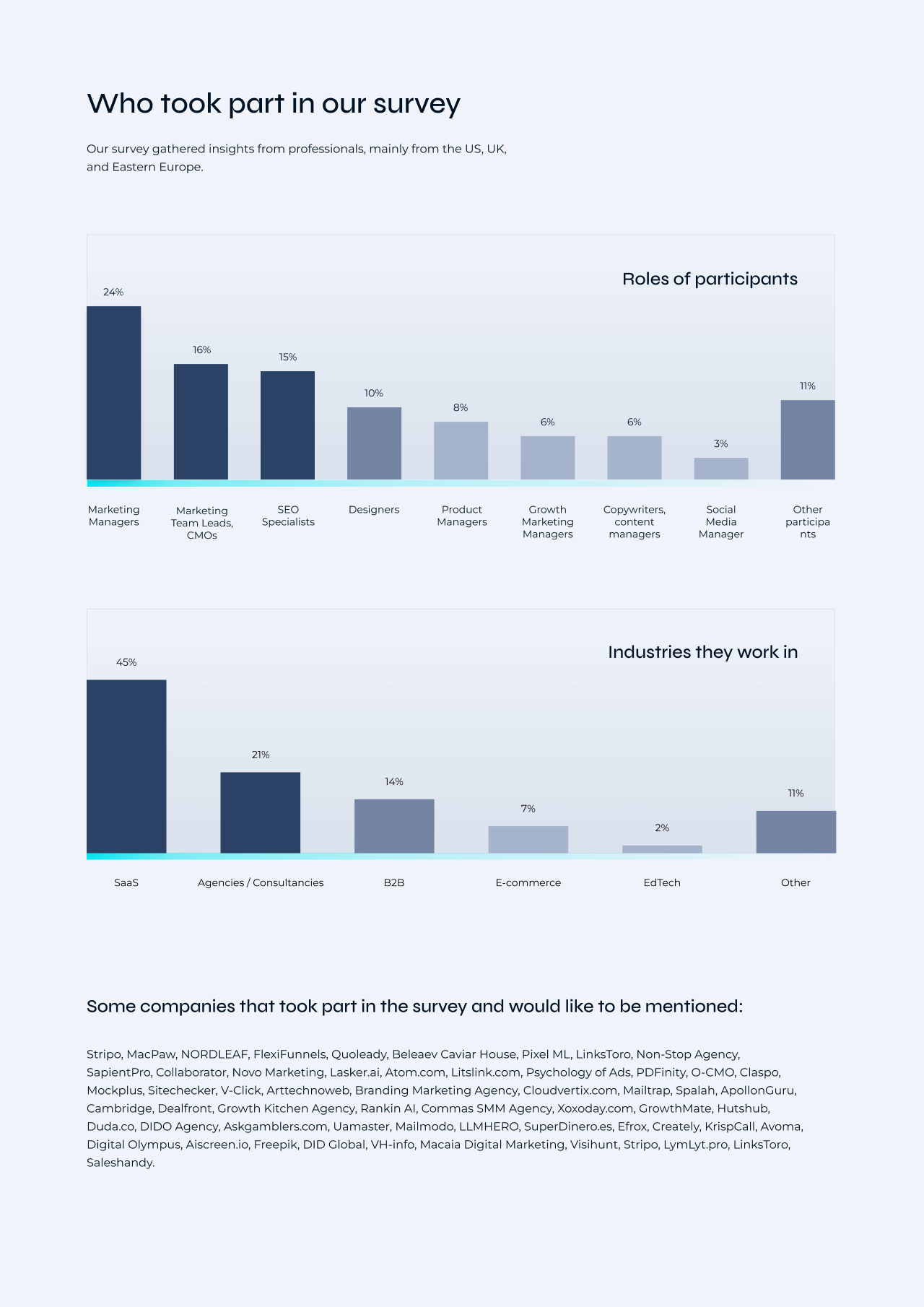
Our survey gathered insights from professionals, mainly from the US, UK, and Eastern Europe.
Roles of participants
- Marketing Managers — 24%
- Marketing Team Leads / CMOs — 16%
- SEO Specialists — 15%
- Designers — 10%
- Product Managers — 8%
- Growth Marketing Managers — 6%
- Copywriters, content managers — 6%
- Social Media Manager — 3%
- Other participants — 11%
Industries they work in
- SaaS — 45%
- Agencies / Consultancies — 21%
- B2B — 14%
- E-commerce — 7%
- EdTech — 2%
- Other — 11%