

Last Updated on 09.07.2026 by Vasyl Holiney
Marketing assets are the backbone of every advertising campaign, generating new leads, engaging customers, and crucially, spreading brand awareness.
But too often, organizations focus on the same elements of their asset management strategy. Assets such as logos, infographics, and articles are crucial. But while focusing on these, it’s easy to overlook other, equally important factors.
Email signatures are a prime example of this. With the right approach, they can be a hidden gem in your broader marketing strategy. But why are email signatures so valuable, and how can they be used effectively?
Why email signatures matter in brand consistency
Whether you’re a freelancer, running a small business, or CEO of a large enterprise, brand identity is always a priority. When you establish a clear identity, customers encounter consistent messaging, style, and imagery across all touchpoints.
This enforces a clear mental image of your brand. Customers will be reminded of your business simply by seeing a certain font or color scheme. Ultimately, regular positive interactions build familiarity. Customers will gain a sense of trust simply from viewing your marketing assets.

Email signatures play a vital role in strengthening brand identity. A survey by the DMA found that 64% of consumers rank email as the primary channel for brand messaging.
As one of the first visual elements a customer notices, your signature creates a sense of cohesion. When used effectively, email signatures reinforce the following:
- Your brand identity – Email signatures usually feature your logo alongside brand colors and typography. They ensure that email isn’t overlooked when building a consistent brand image.
- A consistent tone of voice – Brand identity isn’t only about imagery, it’s also the language used to establish your voice. For example, by signing off with ‘kind regards,’ you reinforce an image of a formal, professional organization.
- Your professional credibility – Whether communicating with clients, co-workers, or networking with external partners, your signature adds a sense of professionalism to your email.
- Ease of contact – Email signatures often include contact details such as phone numbers and social media links. This ensures that customers know how to get in touch without any hassle.
Remember that email signatures are most effective when used alongside other brand assets. Try to apply the same focus to all assets. Your website, social media content, and email campaigns should work in tandem to enforce your image.
Above all, aim for consistency. Creating clear guidelines can help ensure a unified approach to asset creation. You can always A/B test signatures to find a signature template that works. Test designs side by side and find a layout that drives the most engagement.
Email signatures as a scalable marketing channel
Email signatures have a huge potential reach. With organizations often sending thousands of emails per month, and an average 20-30% open rate, a large proportion of customers interact with email signatures.
Email signatures improve scalability by supporting wider marketing campaigns. Listed below are examples of campaigns that signatures assist.
- Promotions – Your signature can advertise ongoing offers or discounts. Rather than spamming customers with marketing emails, this works as a subtle reminder to shoppers. They can click the link and purchase without feeling pushed.
- Content marketing – Signatures serve as a space to advertise your latest blog posts, white papers, and other forms of content. A customer can select a clickable banner and quickly access content.
- Lead generation – By including a calendar app or product sign-up link in your signature, you can boost lead generation. With fewer steps required to take action, customers are more likely to proceed.
- Event announcements – You can use email signatures to flag upcoming seminars, product launches, or in-person events. By including an RSVP link, you can boost attendance.
Best of all, email signatures can be controlled from a centralized platform. This means, rather than individual updates, they can be updated for teams across your organization. You can decide which sorts of messaging are used to support your wider campaigns.
Of course, individual teams can also set messaging. This is ideal if they want to create a personalized approach toward individual customers. For example, if a team is targeting warm leads, they can include lead generation links in their signatures.
To sum up, email signatures are powerful because they help businesses turn passive communication into active marketing distribution.
Aligning marketing assets with business operations
Ultimately, avoid treating assessment management as a set of separate assets, but as a unified group that supports your wider marketing strategies. Together, they should reflect how your business operates. This includes its values, culture, and general approach.
But consistency across branding depends on structured business processes. For smaller freelancers and businesses, this can be more difficult. You’re constantly required to juggle brand consistency, operational compliance, and financial management, all while managing a smaller team.

For instance, imagine you’re a solopreneur managing both marketing presence and business obligations simultaneously. In this scenario, it’s easy for marketing assets to become less of a focus. It’s harder to concentrate on consistent brand messaging while navigating complex compliance obligations, such as sales tax requirements or local business regulations
For greater simplicity, consider how software can assist with business processes. You might use the following solutions
- Brand management tools for visual templates to assist with imagery, logos, and other assets. Marketing automation platforms to sync updates across email tools, CRMs, and marketing apps so signature changes propagate automatically to every system that uses them.
- Compliance software to identify risks and keep up-to-date with legislation, whether that’s IRS self-employment tax requirements in the US or Making Tax Digital for sole traders in the UK.
- Financial management tools to automate bookkeeping and provide a centralized view of business finances.
Establishing a shared vision ensures more efficient asset creation. With all departments working towards a common goal, you can avoid disputes that impact other business processes.
Industry examples: Where email signatures reinforce brand identity
There are clear reasons why businesses from all industries use email signatures. Alongside a useful marketing asset, signatures act as an element of verification. They demonstrate that an organization is professional and trustworthy to customers.
According to research from Exclaimer, 64% of consumers say a professional branded email signature increases their trust in the sender.
There are also industry-specific reasons for using email signatures. Let’s look at some examples of different industries and how they benefit from signatures.
- Creative freelancers & solopreneurs – A freelancer might include a link to their portfolio or links to LinkedIn within their signature. This eliminates the need for the client to request a link, helping secure commissions more quickly.
- Cafés and small hospitality businesses – Hospitality businesses could include a booking link within their signature, increasing attendance at events. A cafe might use a signature to showcase weekly specials.
- Trades – A tradesperson could display social proof and testimonials, boosting customer confidence. They could also provide links for customers to leave reviews upon completion of work.
- Hair & beauty businesses – A salon might provide information about gift vouchers during holiday seasons, or a referral link for customers to share with friends.
Best practices for managing email signatures as marketing assets
Standardized templates for consistency
Standardization is an essential part of managing your email signatures. Just as organizations rely on an IT employee onboarding checklist to ensure new hires receive consistent tools and access, every customer should encounter the same brand identity via email, social media, or while viewing a physical product.
This isn’t possible when different employees have their own approaches to email signatures. When aiming for a consistent, standardized approach, try to meet the following criteria.
- Use the same font and color schemes as official brand releases.
- Make sure all signatures share the same contact details (phone number, LinkedIn, etc.)
- Use font sizes that are viewable on mobile devices and avoid large images.
Create a signature template so that all employees follow the same approach. This should ensure that employees fill out pre-defined fields when creating their template.
Updating campaigns without breaking brand identity
The most effective email signatures adapt alongside your marketing campaigns. They should include the same CTAs and core messaging, banners, and other elements.
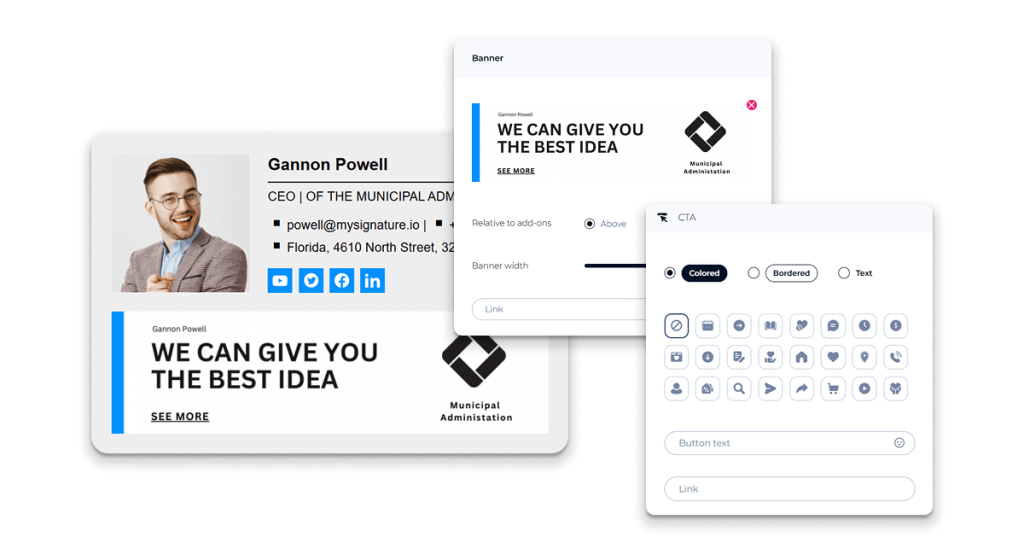
This is much easier when using a solution that enables signature updates from a centralized space. You can apply updates to employee emails at the start of a campaign to ensure consistency from the get-go.
Avoiding clutter and maintaining clarity
Remember, your email signature is not designed as a billboard. Its primary purpose is to act as a professional way of signing off an email, as well as providing additional contact details. Customers are less likely to feel engaged the moment it becomes an advertisement.
Avoid providing too much information. A reader should be able to absorb key insights at a glance; they won’t be able to do so if your signature is crammed with too much text. Restrict content to 2-3 lines to keep your messaging concise.
Equally, too many images or colors can damage your professional branding. Stick to small-sized images and colors that reflect your brand identity.
Lastly, to maintain clarity, employees should review their signatures regularly for outdated information. Update to reflect any changes and avoid customer confusion.
Email signatures as part of a unified brand system
Presenting a unified brand is everything in business. For smaller organizations in particular, it’s a chance to stand out from the crowd and enforce your unique proposition. Brand assets are an essential element in this strategy. Together, they form the public face of your business.
But while it’s common practice to focus on logos, banners, and social media content, don’t forget the importance of email. An email signature boosts your brand voice and saves time.
MySignature is an online signature generator that helps professionals get the most out of their emails. You can create high-quality branded email signatures for Gmail, Outlook, Apple Mail, Thunderbird, and Office 365 clients. Best of all, you choose from hundreds of professionally designed templates – no expert knowledge required.
Find out for yourself, create your signature today.