
Last Updated on 06.10.2026 by Vasyl Holiney
Despite investing heavily in project management software, performance dashboards, and hybrid work infrastructure, a lot of companies still face problems with productivity. When deadlines slip, and decisions take too long, talented people tend to quietly disengage. I spent three years watching a global consultancy roll out four consecutive collaboration platforms trying to fix exactly this problem. What almost nobody thought to examine was communication itself. When talking about communication, it’s not just about the tools used to deliver messages. It’s also about the human skill behind it.
The data tracking this is hard to ignore. According to Grammarly’s 2024 State of Business Communication report, miscommunication costs U.S. businesses an estimated $1.2 trillion every single year. The Association for Talent Development puts this another way: the average return on communication training investment becomes $4.50 for every $1 spent. And yet most organisations look at that gap and call it a process problem; tweaking the workflow, adjusting the org chart before rolling out another initiative. The one thing they almost never try is structured communication training, delivered by people who actually specialise in it. However, this turns out to be the intervention with the clearest return. It’s overlooked so consistently that for anyone paying attention, that’s precisely where the opportunity is.
Key Takeaways
👉 Productivity problems are often misdiagnosed as process or tool issues, when the real bottleneck is how people communicate.
👉 Communication isn’t a soft skill, it’s the core operational layer where most time is spent and most friction happens.
👉 Small communication gaps compound into major business costs, from missed deadlines to employee turnover.
👉 The biggest breakdowns start at the manager level, where expectations are set but communication training is often missing.
👉 Real gains come not from knowing communication principles, but from building practical, high-stakes communication skills across the organization.
The Hidden Line on the P&L
While it might appear so at first glance, the financial case against poor communication is not subtle at all. Research compiled by PassiveSecrets shows that it’s poor communication that’s the cause of 70% of company mistakes. This translates to almost $37 billion in annual productivity losses related specifically to communication barriers across 400 corporations.
Aside from direct losses, the retention math compounds the damage. According to SHRM, businesses that communicate effectively are 50% more likely to experience high employee turnover. Replacing a single employee costs an average of 33% of their base salary. This is a significant and largely visible overhead for mid-sized companies losing ten people a year partly due to communication-driven disengagement.
I worked with a logistics company a few years ago that was cycling through project managers at an unusual rate. Exit interviews pointed to “culture” and “lack of direction.” When we dug into the actual communication patterns, the real issue was that senior leaders were issuing priorities verbally in one-on-ones that contradicted what was written in project briefs. Nobody had flagged it because nobody had a shared framework for how decisions were supposed to be communicated. Three months of structured communication work, no new software, no restructuring, reduced voluntary departures in that function by half.
According to Pumble, 86% of employees and executives identify poor communication and collaboration as the primary cause of workplace failures. And 28% of employees cite unclear communication as the direct reason they miss project deadlines. These aren’t cultural indicators. They’re operational ones.
Why More Tools Won’t Fix This
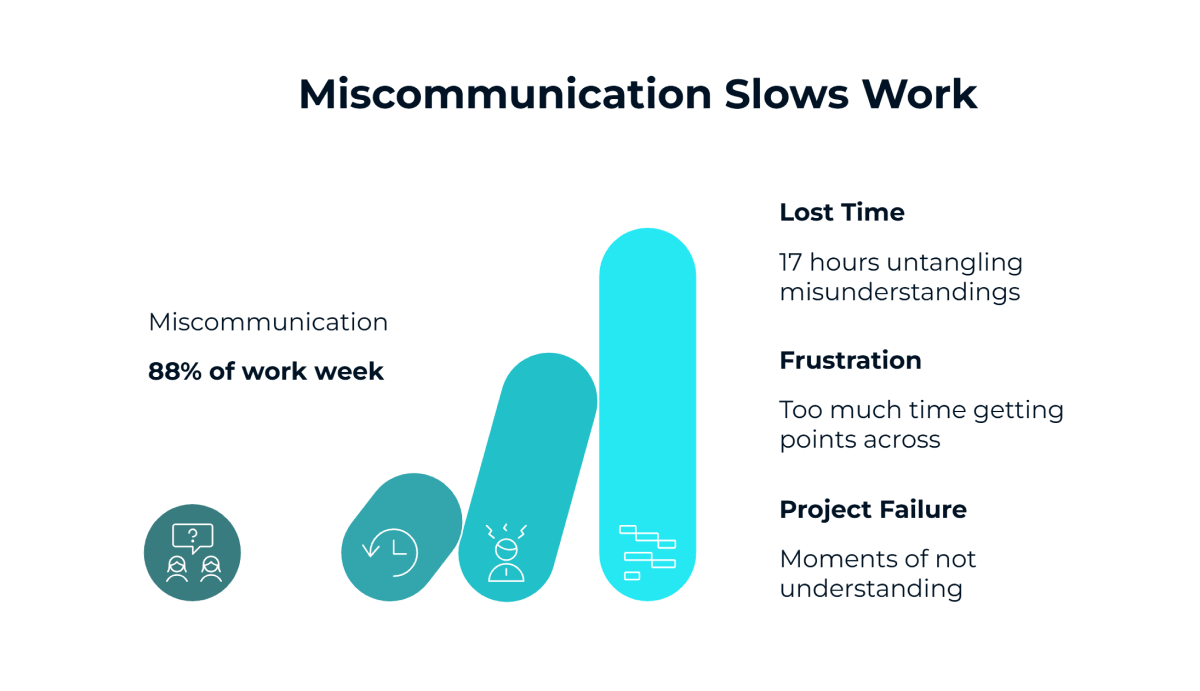
Think about what knowledge workers actually do all day; they write emails, sit in meetings, send messages, jump on calls. According to the research, communication accounts for roughly 88% of a working week. That’s not a rounding error, it’s almost everything someone does each day. And when the core activity of a job is also its biggest source of friction, even small improvements compound fast. That friction is significant; workers lose up to 17 hours every week just untangling misunderstandings — nearly half a working week, every week, gone. More than half of professionals say they spend too much time trying to get a point across that should have landed the first time. One in four deal with miscommunication not occasionally, but multiple times a day.
The instinctive response is to blame the infrastructure. So organisations buy new platforms, open new channels, rebrand the intranet. What they rarely do is teach anyone how to frame a decision so it’s actually actionable, how to push back in a meeting without derailing it, or how to read a room and adjust accordingly.
For distributed teams and employees working internationally, communication friction is also increasingly tied to connectivity reliability, which is why many remote professionals now rely on tools like an eSIM app to maintain stable mobile access while traveling between countries.
I’ve sat through enough post-mortems to know how this plays out. A project goes sideways, the debrief produces a tidy list of process failures, and the fix is another tool or another standing meeting. What never makes the list is the moment three weeks earlier when someone didn’t understand the brief and said nothing, or when a manager’s direction was so hedged it could have meant anything. Those moments are where the project actually broke. They’re just harder to put in a slide.
That’s not a process problem. It’s a skills problem, and it doesn’t go away when you migrate to a new platform.
Why Most L&D Programs Stop Short
When employees receive genuinely skilled communication training, productivity increases of up to 30% are documented. Teams that communicate effectively achieve productivity gains of up to 25%, according to Pumble’s 2025 research. Companies with strong internal communication are 3.5 times more likely to achieve better outcomes than those without it.
Knowing that clarity matters and actually producing it are two very different things. Most people in most organisations understand the first. Far fewer can do the second; especially when the stakes are high, the audience is unfamiliar or the conversation is one nobody wants to have.
That gap is where most corporate L&D quietly falters. Giving a workshop on active listening or recording a module on giving feedback isn’t useless, but they describe good communication rather than help people embody it. Knowing what a difficult performance conversation should look like doesn’t prepare you for the moment you’re actually sitting across from someone whose role you’re about to change. That requires a different kind of learning, and communicating, entirely.
And what actually enables this behaviour shift is watching someone do it well; like an expert practitioner. Someone who has coached a CEO through a media crisis, or built a sales team’s communication discipline from scratch can more aptly show what precise, confident communication looks like in conditions that aren’t comfortable or controlled. Those are the lessons a workbook can’t deliver: a live demonstration of a skill under pressure.
It’s why more organisations are going outside their internal L&D function for this kind of work. The expertise they need exists, but it tends to live in people whose credibility comes from experience rather than certification. An example of this is the PepTalk speaker marketplace, which connects companies with verified communication experts across negotiation, public speaking, emotional intelligence, and leadership communication, practitioners whose credibility comes from applied experience rather than certification.
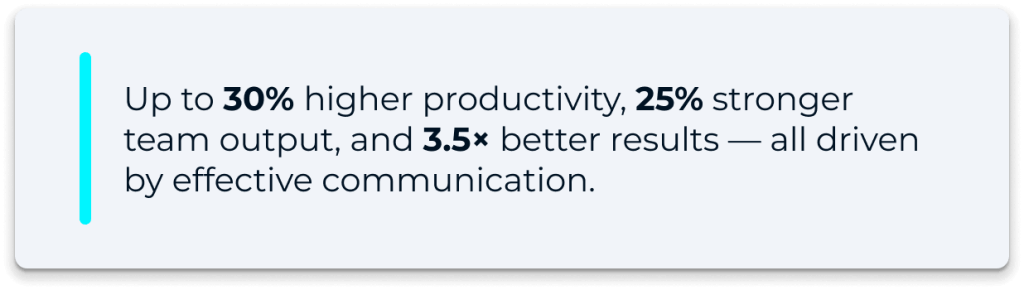
The returns are well-documented. Genuinely skilled communication training creates productivity increases of up to 30%. Teams that communicate effectively see output gains of up to 25%, according to Pumble’s 2025 research. Companies with strong internal communication are 3.5 times more likely to achieve better outcomes than those without it. None of that comes from awareness. It comes from competence, and lasting competence has to be built.
60% of First-Time Managers Don’t Get Communication Training
The communication skills gap is most damaging where it’s most concentrated: at the manager level.
According to research from CEB/Gartner, nearly 60% of first-time managers received no management training when they moved into leadership. These are the people responsible for translating strategy into daily action, running team meetings, delivering performance feedback, and managing the interpersonal friction that determines whether a team functions or fragments.
In my experience, the newly promoted manager is almost always the last person to receive communication development and the first person blamed when team performance drops. I’ve worked with managers who were exceptional individual contributors, technically brilliant, deeply trusted by their peers, who fell apart the moment they had to run a difficult conversation or present a strategic case to senior leadership. The skill that got them promoted had nothing to do with the skill their new role demanded.
The communication breakdowns most organizations diagnose at the team level almost always originate at the manager level. When a manager can’t communicate expectations clearly, their team can’t execute them cleanly. The downstream effects look like execution failures: missed deadlines, unclear priorities, inter-departmental conflict. They’re communication failures wearing a different label.
Gallup’s 2024 data shows that 70% of the variance in team engagement is attributable to the manager. ommunication training that targets managers specifically, rather than broadcasting generic workshops across an entire organization, produces faster and more measurable returns, which is really just one of several cost-saving strategies available once you stop treating training spend as a blanket expense. Fix the communication at that level first, and performance metrics across the rest of the organization tend to follow.
Credibility Loads Before Your Content Does
Communication training focuses on spoken and written content, but credibility doesn’t start when someone reads your message. It starts the moment your name appears in their inbox.
A professional email signature is not a formality. It’s the first signal a recipient uses to assess whether the sender is worth their attention. In an environment where the average office worker receives 117 emails per day, anything that reduces the gap between “who is this person” and “I’ll read this now” is a functional communication asset.
This is something I started paying attention to after noticing how often first impressions in client relationships were being shaped before a single word of content was read. A salesperson on one team I worked with was getting consistently low response rates on outreach that was, by any reasonable measure, well-written. The emails looked unprofessional at a glance: no signature, no title, no company context. The content never got a chance. We fixed the signature, added her title and a one-line company description, and response rates on cold outreach improved by roughly 30% within three weeks. The writing hadn’t changed. The credibility signal had.
Tools like MySignature address exactly this layer of the communication picture. A consistent, well-structured signature standardizes the credibility signal across every person on a team, which matters most in client-facing roles where first impressions are distributed across dozens of individual email conversations happening simultaneously. It doesn’t replace communication skills. It removes a variable that undermines it.

It works by letting teams design and manage email signatures in one place and apply them across all employees in tools like Gmail and Outlook. It is commonly used by small businesses, SaaS teams, and sales or customer support departments that rely heavily on email communication. In this context, it helps maintain consistency without adding extra manual work for employees.
Organizations that think about communication at this level, from how a speaker frames an argument in a workshop to how a sales rep’s signature reads on a cold outreach, are treating communication as a system rather than a series of isolated events. That shift is what separates organizations that run communication training from those that actually improve communication.
Before the Next Quarter, Ask This
Before the next quarter’s performance push, before the next software rollout, one question is worth sitting with: how well do people at every level of this organization communicate what they know?
The knowledge gap in most companies is smaller than the communication gap. The information exists. The expertise is there. What’s missing, in meeting rooms and email threads and presentation decks alike, is the ability to move that knowledge clearly and efficiently to the people who need it.
Grammarly’s research found that 43% of business leaders report gaining new business directly because of effective communication, a 10% increase year-on-year. Teams that feel well-informed and genuinely heard are 71% more productive than those who don’t. Neither number comes from a platform upgrade.
The $4.50 return on every $1 invested in communication training is not a soft metric dressed up in numbers. It’s what happens when organizations stop treating communication as background noise and start treating it as infrastructure.