
Last Updated on 10.07.2026 by Vasyl Holiney
When I started my career as a PR specialist in Telenor—a telecommunications corporation with a global presence—I wrote all my work emails like diplomatic correspondence.
I thought it was appropriate. My university taught me that writing style. And I didn’t hesitate to use complex paragraphs, long sentences, and formal clauses. It wasn’t a bad choice after all; recipients never complained or commented negatively on my writing. However, the response rate was not great.
It wouldn’t be a problem if only I weren’t managing a big corporate survey, where the response rate was a key success factor.
Through trial and error, I adjusted my communication strategy and understood that clear, concise, and personalized language works much better. Recipients asked me fewer clarifying questions; their engagement levels and response rate were significantly higher (37% higher, as I was measuring everything through my survey).
That’s how I learned firsthand about the impact of communication style choice on business outcomes and on my personal brand. In the digital economy, clear text formatting directly changes how clients perceive your authority and pricing power.
In this article, I want to share with you a four-step framework based on my data to help you optimize your digital reputation and team efficiency.
Key Takeaways:
👉 Professional communication directly influences digital reputation by shaping how clients perceive your credibility, expertise, and authority.
👉 A well-structured email signature strengthens brand consistency, builds trust, and can turn everyday emails into reputation-building touchpoints.
👉 Clear formatting, short paragraphs, and specific metrics make communication easier to understand and increase reader engagement.
👉 A conversational expert tone helps businesses stand out, justify premium pricing, and build stronger connections in crowded markets.
👉 Simple, direct communication reduces friction, improves team efficiency, and creates more positive experiences for customers and employees.
1. Why is digital reputation your primary conversion metric
Everything you write online, including emails, messages, and your public profiles, leaves a visible digital trail that acts as your primary conversion filter.
In my career, I’ve worked in PR, marketing, and HR and have periodically noticed how much business owners overestimate their websites, products, and landing pages. If anything goes awfully wrong with sales or things don’t go as well as expected, they’d rush to check the landing pages and blame the marketers.
What they miss is something more fundamental and harder to fix when problems arise—their corporate and personal branding, the digital reputation shaped by their communications.
These are not just words, but a well-tested theory proved by hard facts: buyers actively check one’s digital trail before signing a contract or purchasing services:
- 93% of consumers read online reviews before making a purchasing decision.
- 40% of consumers check at least two separate review networks while browsing businesses to verify online credibility.
- 81% of buyers actively consult Google Reviews to evaluate an entity before committing capital.
Conversion rate increases proportionally by the number of reviews:
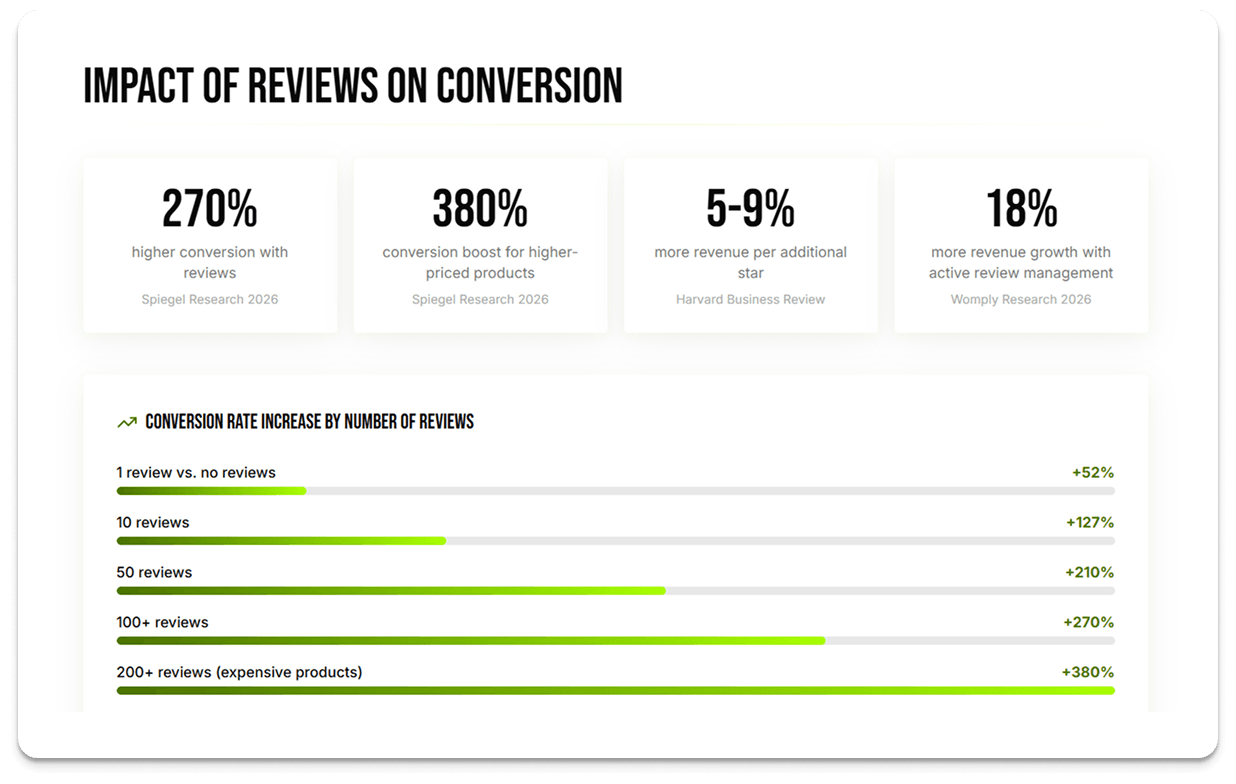
source: Searchlab
Users actively browse the web to read about an unknown brand or product, and, in doing so, they often come across public profiles of business owners or their public speeches, videos, and podcast appearances. Any stain on reputation will be visible and will have an immediate negative effect on potential consumer choices.
The bottom line: Your digital reputation is the ground layer upon which all further marketing activities should be built. Don’t waste your marketing dollars if your foundation is broken. First, get the basics right, then plan market expansion or client acquisition campaigns. You cannot convert traffic if your professional communication destroys your credibility.
2. Email signature architecture impacts sender authority and reply ratios
Marketers treat emails as a slow but impactful business communication channel that can improve visibility, drive organic traffic, and boost conversions. They spend lots of time and dedicate whole budgets to running large-scale email campaigns.
What they don’t do is pay attention to details.
According to the recent Email Marketing Statistics Report by Newoldstamp, 66.9% of professionals send up to 10 personalized corporate business emails daily. Yet an overwhelming 71.3% of them fail to track or evaluate their email signature performance.
They don’t understand that an element as tiny and seemingly insignificant as an email signature impacts their brand authority and reply ratios even more than lengthy texts.
Labeled dynamic links outperform generic contact text layouts
Dynamic, clearly labeled links and descriptive call-to-action text help users see the senders’ personality behind a generic signature. These features sharply contrast with raw, static URLs, which repeat for thousands of emails sent across several independent campaigns.
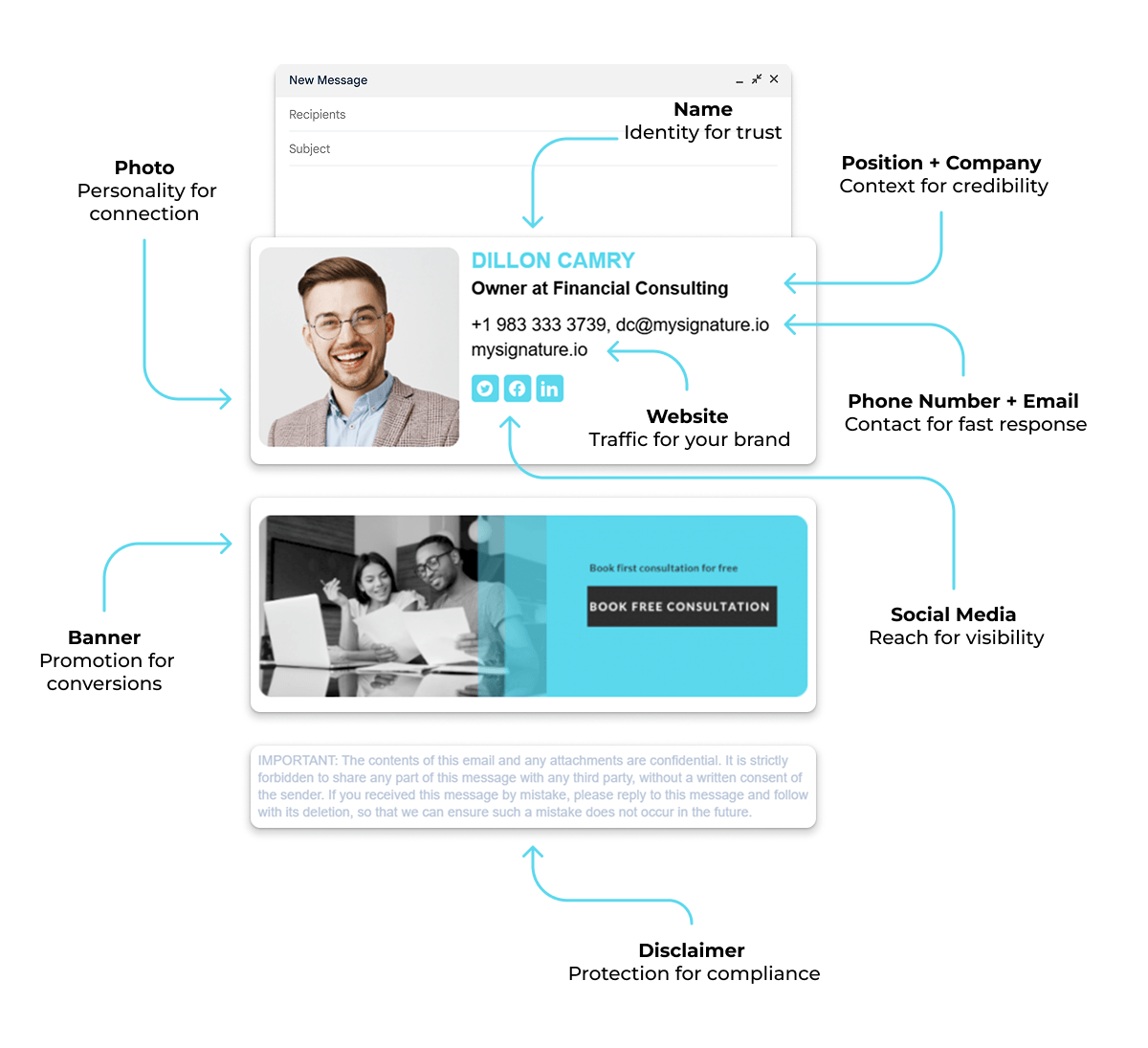
Personalization should not stop at email text, where you change the recipient’s name, their position, or reference their recent work. That’s what everyone else does. Doing the same won’t help you stand out.
The links and CTAs in the email signature also deserve personalization. The key success recipe here is not to overdo the whole thing—one link per signature and one clear CTA will do the job much better than several stacked on top of each other.
Focusing on a single high-quality destination helps you consolidate your link authority and ensures your recipient takes the exact action you want. Tools like MySignature make it easier to create branded email signatures with personalized CTAs, social links, and interactive elements that turn everyday emails into valuable touchpoints.
Unified branding elements validate business legitimacy
Your digital reputation is the sum of all your communication on the web, including your email signature. Integrating your email footers into your broader reputation management strategy is critical. When your brand logo, social icons, and legal details in every email signature match the relevant information on your website, this creates trust and reduces recipients’ resistance over time.
Don’t expect immediate results. Emails take time to shape a professional image of you. The key benefits to your brand reputation come from repetition and consistency when you don’t change your corporate logo and use the same font style and colors across thousands of emails sent.
To get started, stick to these four practical signature branding rules:
- The two-color limit: Use only your primary corporate brand colors for text and icons.
- The web-safe font rule: Stick to universal system fonts like Arial, Calibri, or Helvetica to prevent rendering problems on different operating systems or mobile devices.
- The compressed PNG standard: Export your corporate logo as a 150-pixel-wide PNG file to correctly display and load instantly on all mobile devices, irrespective of their bandwidth.
- The limited social icon array: Include only up to three different social media icons (dynamically choose which ones to match your recipients’ profiles).
3. Text formatting choices change how clients perceive your authority
Something as simple as text formatting plays a huge role in shaping your digital reputation. Consider it a low-hanging fruit, your quick win, and the ultimate starting point for reputation management if you want to improve how your clients perceive your authority.
I learned through my own communication data that dense blocks of text signal a lack of operational clarity. Busy prospects do not wade through walls of prose to find your core value. They skip, close, and bounce off.
Skimmable layouts prevent reader drop-off and boost response rates
If your emails look like an academic essay or coursework, don’t expect a high response rate.
I tracked reader engagement across over 30,000 emails sent in one survey campaign. And I did that for several consecutive years. What I found was that visual structure has a direct impact on response rate and speed.
When you structure your text for easy reading and comprehension, even at the expense of some details, you respect the recipient’s time. It’s hard to predict the mood and time of day when a recipient might open your email.
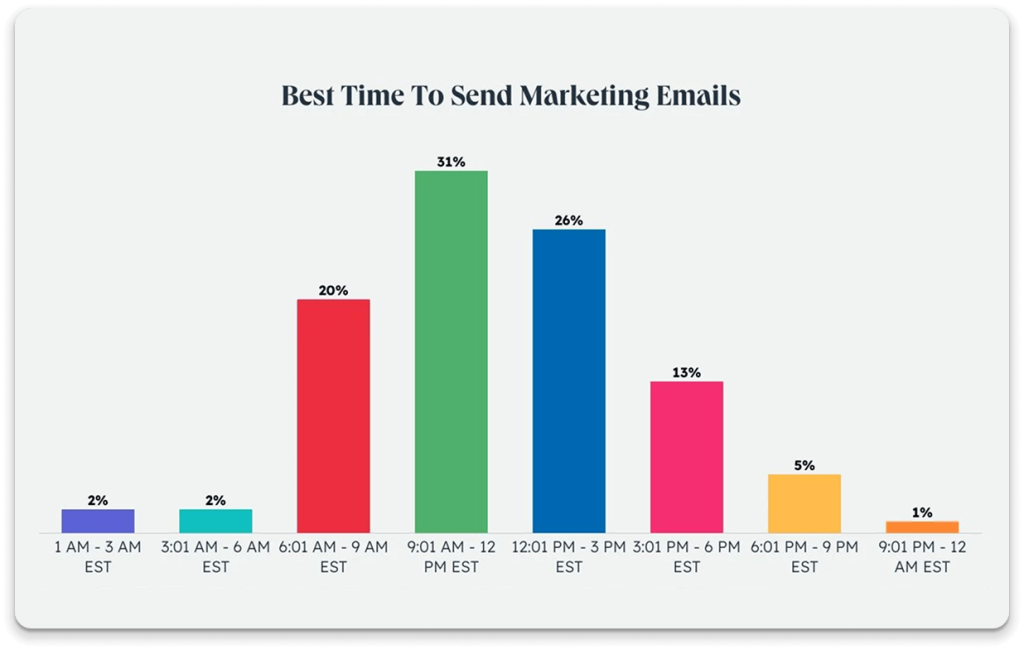
source: Hubspot
And the safest way to cut through the recipient’s fatigue is to use skimmable layouts. How? Start with these simple things:
- The two-sentence ceiling: Keep paragraphs under three lines long to create immediate white space.
- Bold anchor phrases: Highlight your key ideas and messages in bold. Even the busiest reader will be able to grasp those while scrolling through your email.
- Fragment lines: Insert single-sentence paragraphs to emphasize your key points, main takeaways, and crucial questions.
Bulleted lists with specific metrics establish instant trust
I stopped using vague adjectives like “extremely useful” or “massive growth” in my communication with clients. Adjectives are used when there is nothing else to say or back up your claims. Together with heavy paragraphs and long sentences, they kill your authority and trust.
Instead, I began using shorter sentences and bulleted lists, but only when it makes sense. But lists alone are no longer enough. Everyone, including AI bots, can generate lists these days.
What works even better are lists with specific metrics. If you want to focus on building trust through communication, ditch the vague filler copy and quantify your exact achievements:
- Revenue performance: Increased organic revenue by 24% over a rolling six-month campaign window.
- Lead generation: Expanded the active sales pipeline from 1,200 leads to 3,500 qualified prospects.
- Operational speed: Reduced onboarding bottleneck delays from 14 business days to 4 days.
Even in the HR field, seeing a CV of a job candidate where they prove their experience and achievements with specific numbers makes all the difference. Suddenly, all other candidates who use vague “enhanced significantly”, “greatly improved,” and “actively contributed” lose trust.
And it’s not only marketing or HR. Any professional domain where digital reputation depends on the quality of communication can tell you a similar story.
4. Brand voice determines your pricing power in a crowded market
Businesses often compete on cost because their outreach voices sound identical to the consumers. What each lacks is a distinct brand voice that stands out in the crowded market.
Conversational expert tones justify premium project rates
There is no lack of generic, formal, and robotic voices on the web today. Given the ease with which AI churns out identical sales pitches and promotional texts, consumers treat every comparable offer the same. They have no choice but to choose between the cheapest offerings.
Clear, accessible text, written in a conversational tone, signals mastery. This is what I learned in my professional career: you don’t actually need to display your university degrees, awards, and other achievements if you know how to present yourself as an expert. True thought leadership comes down to accessibility and confidence.
And the key to sounding like an expert is simple: avoid complex business jargon and speak to your buyers directly as if they are your best friends. True experts do not need to overcomplicate their prose to prove their worth.
Nothing overly complex. If you are a project manager (like I was during the bulk of my career), start by embedding these three professional communication principles to establish yourself as an expert in the eyes of your consumers:
- Practice radical transparency by addressing project bottlenecks and realistic timelines directly during the initial communication with your clients (e.g., on project kick-off and scoping meetings).
- Prioritize simplified phrasing to strip away defensive, old-fashioned corporate clauses and make your main points immediately clear.
- Take an assertive position to immediately state your commercial terms without using filler words, excuses, and uncertainty disguised as complex business terminology.
Direct answers eliminate the friction of long email threads
Jason Fried and David Heinemeier Hansson, founders of software firm Basecamp, have long noticed how long emails kill employee engagement and reduce their productivity. They’ve issued their famous “Internal Communication Manifesto”, also known as “The 37signals Guide to Internal Communication” (37signals is a parent company of Basecamp).
The manifesto explicitly states that long emails and group chats should be avoided, if possible. Instead, employees should practice simple, direct answers and short group messages.
The result? Once the guide became an official corporate blueprint for internal communication, the internal communication anxiety reduced by 80% and gave developers back 2 hours of uninterrupted focus daily.
It’s good that some leaders in some companies have the courage and find time to acknowledge and do something to fix those productivity killers in corporate communications.
But what do we see in most corporate chats and email threads? Vague communication requires multiple follow-up sessions, and groups of employees engage in hours-long off-topic discussions just to please their egos. This is so counter-productive and wasting the engaging potential of an effective internal communication:
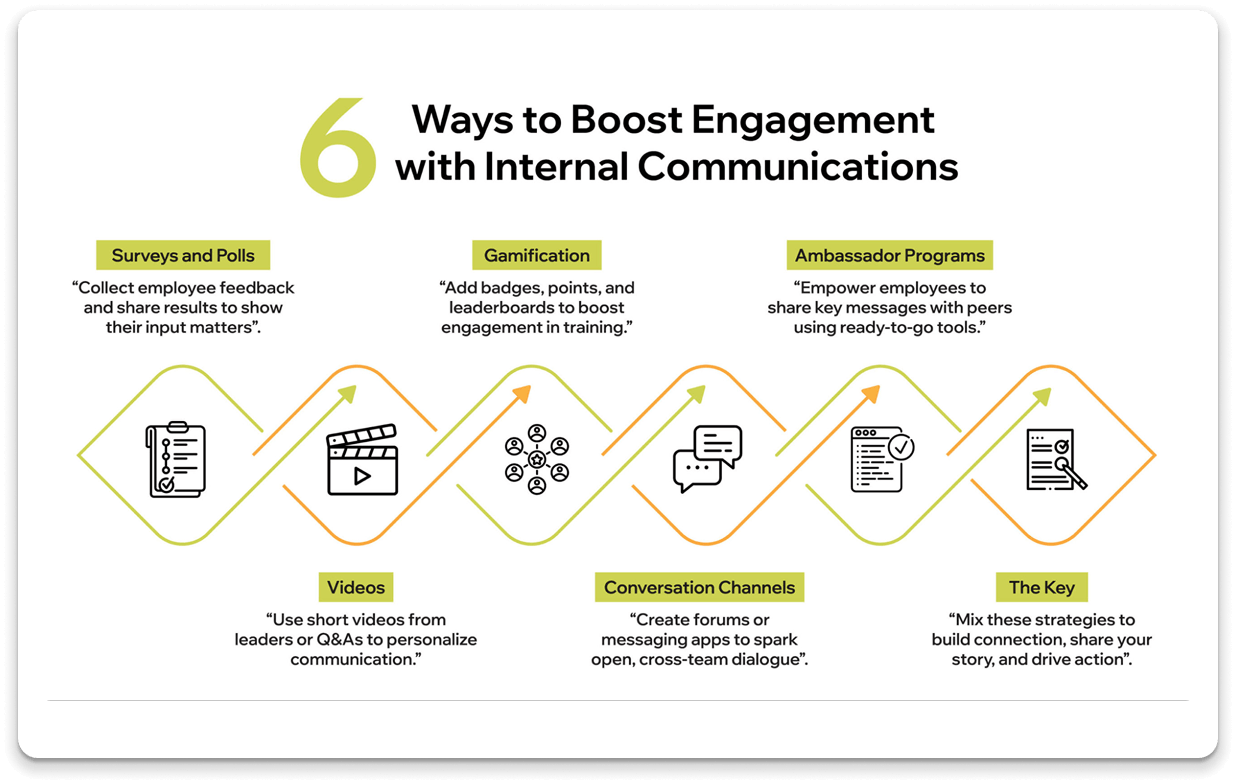
source: Brandemix
The bottom line: A direct and simple writing style is more efficient than a vague, complex, and impersonal style. Concise messaging builds immediate operational trust and protects your valuable time. But it takes maturity and courage to accept this and act to improve how your employees communicate.
The bottom line
True online reputation management is less about expensive PR campaigns you buy and more about the little things you do in your everyday communication. Emails, and particularly email signatures, are one of those little details that have a massive impact on your digital reputation.
And contrary to popular belief, what works best is not the clever things you communicate, but the format and appearance of your messages. Things like layout, font style, and clear, direct writing tone help both human readers and AI systems understand and remember your corporate or personal brand.
Focus on these key habits to make your text more effective:
- Skimmable layouts help prevent user drop-offs and boost response rates.
- Specific metrics and stats formatted as clear bulleted lists work as instant attention grabbers.
- Conversational expert tone builds genuine brand trust much better than academic and complex business language.
- Direct answers eliminate the downsides that come with long email threads.
- Unified email signature architecture validates your business legitimacy and converts passive footer traffic into active leads.
Every time I read a dry, machine-made message, I recall what Maya Angelou once said about good communication: “I’ve learned that people will forget what you said, people will forget what you did, but people will never forget how you made them feel.”
Visual mess and complex text make me feel tired and irritated. On the contrary, scannable, direct text personalized with contextual links and topped with relevant emojis makes me, as a recipient, feel valued.
The question is, will your communication respect your reader’s time and convert them into a partner, or will it just become more noise in their inbox?